legal/
illegal - art beyond law
artists:
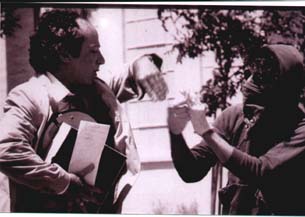
Chris Burden, Arthur Cravan, GAAG, Abbie Hoffman, Tony Labat (Foto), George Maciunas,
Ann Messner, Dennis Oppenheim, p.t.t.red, Antonio Riello, Janice Kerbel, Jackie Sumell, Jean
Toche, Timm Ulrichs, Georg Winter...
Legal,
Illegal, ... is concerned with actions from artists, in which the borderline between
artistic staging and political act disappears, in which symbols run into actionism,
illegality, or even criminality - actions that refuse strict categorization and
seek a conflict between the systems of politics, art, and life. The project is
based on the research of artistic strategies of scandal in their respective medial
and political contexts. It will analyze actions that take place in the formal
context of freedom of thought and freedom of the arts that, however, consciously
quit legality in a gesture of provocation or scandal production, in order to address
political and social conditions or else to question the art system itself. The
focus of the project starts with the beginning of the 20th century. It is the
aim of the project to examine the conditions, effect, and ambivalence of such
actions: - What is their influence on the art system and on politics? - Which
are the medial conditions for the effectiveness of such actions? - Is there a
specific psychosocial artistic identity behind scandal production? - Where is
the borderline of legitimacy? And can the art status guarantee immunity? The presentation in Berlin will take place on three different levels: actions
and interventions in public spaces, an "exhibition", and a book. Actions, interventions:
Since it is in the nature of these actions that no traditional work of art is
created and that direct documentation is often sparse, the exhibition will try,
when possible, to present the respective actions with the help of the original
actors. A subjective and personal retrospective view of the event will help the
theme to gain in liveliness and topicality. The ideas of the historical actions
will be presented outside of the NGBK space, in the form of posters, newspaper
ads, leaflets, Internet, websites, and film. The
"exhibition" will take place in the NGBK space (c. 250 m2). In order to do justice
to the theme and to the sensitivity of the actions, the exhibition space will
be treated as a drop-in center, a bar or café, a base camp for the actions and
interventions. In Berlin, additional space for installations is available. Films
and videos will be shown at a program cinema. Should the original actors not be
available, the project will concentrate on film material (i.e. Arthur Cravan,
Abbie Hoffmann, International Situationists).
The catalogue will include 6 - 8
comprehensive essays by prominent authors, contributions by artists, documentary
texts, and interviews. In addition to a further compilation of pieces still yet
to be researched (that in a later phase will be selected according to strict criteria),
the essays will treat general issues such as: art and sabotage / terrorism / smuggling
/ theft / invented identities / guidance towards illegality / the history of politico-artistic
actions / methods and aims of illegal artistic actions / the legal situation.
Further venues: The project aims at being presented at several venues (maybe 4),
such as NYC and Graz. Here, the exhibition form and the choice of actions can
of course vary from the presentation in Berlin. It is generally to be remarked
that the nature of such "artistic actions" makes them occur most frequently in
times of political and social unrest. People, whose interest is social criticism
rather than personal headlines, often initiate them. Their actions serve "consciousness,
readiness, and awareness" (quote Hakim Bey / Die temporäre autonome Zone, Berlin
1994). Looking back, the actions are suspended between myth and reality - one
of the reasons for this is that they have often been handed down to us through
imprecise or exaggerated press accounts. One
of these mythical figures is the writer Franz Jung (1888 - 1964), known to us
today principally through his autobiography "Der Weg nach unten" ["The way down"]
(1961).In 1920, Franz Jung agreed to travel to Moscow for the KAPD (a section
of the German communist party). His mission was meant to "reveal the dangers incurred
through the sinking of members into political apathy and slavish obedience". With
the help of a sailor and together with another comrade, Jung boards the trawler
"Senator Schröder" in Cuxhaven as a blind passenger; the ship is bound for Iceland.
At the height of Helgoland the clandestine passengers, declaring themselves to
be representatives of the "Russian Soviet Republic" emerge and force the trawler
to take course on Russia. Sailing under the red flag through minefields and without
any maps, the trawler reaches Murmansk on May 1, 1920. Jung is then escorted to
Moscow via Petrograd and the "Senator Schröder" is handed over to Russian port
authorities. The trawler finally makes its way back to Cuxhaven, where the crew
is thrown into jail. "Understandably, that no longer interested me" is the comment
provided by anarchist Jung in his autobiography. We
now move on in time to the first years of the war in Vietnam and to the founding
of Fluxus by George Maciunas, who describes the goals of the movement as follows:
"Fluxus objectives are social (not aesthetic). They are connected to the group
of LEF… of 1929 [sic] in Soviet Union (ideologically) and concern [themselves]
with: Gradual elimination of fine arts […]. This is motivated by desire to stop
the waste of material and human resources… and divert it to socially constructive
ends […] Thus Fluxus is definitely against [the| art-object as non-functional
commodity - to be sold & to make livelihood for an artist. It could temporarily
have the pedagogical function of teaching people the needlessness of art including
the eventual needlessness of itself. It should not be therefore permanent." (letter
to Tomas Schmit, 1963, quoted from: C. Phillpot, J. Hendricks (ed.): Fluxus. Selections
from the Gilbert and Lila Silverman Collection, MoMA 1988). As recorded in the
internal information organ "Fluxus News Policy Letter" no. 6 of 1963, plans for
sabotage were from the start part of the program. One plan saw the blockade of
bridges and tunnels with trucks and cars covered in Fluxus posters. A traffic
chaos would then paralyze Manhattan. Another idea planed the distribution of a
fake issue of the New York Times with news of the closing down of famous museums,
together with Fluxus propaganda. The protagonists were definitely intent on attacking
the traditional art scene: Classical concerts were to be disrupted by smoke or
stink bombs, exhibition previews by the delivery of palm trees and bricks etc… In January 1970, the radical section of the Art Worker's Coalition called "Guerrilla
Art Action Group" or GAAG (1969-1976; counting in part the same members as the
Fluxus movement) became known by holding a memorial service dedicated to the massacre
of Song My, a Vietnamese village, in front of Picasso's Guernica. A baby lying
on the floor surrounded by wreaths was part of the action, which took an end as
soon as the police arrived alerted by museum officials. Jean Toche, Belgian destruction
artist and together with Jon Hendricks founder of GAAG, is arrested by FBI officers
because of threatening to kidnap museum directors if the Iranian Tony Shafrazi
is not liberated. Shafrazi had been jailed in 1974 for spraying the words "KILL
LIES ALL" on Picasso's Guernica. He was released on bail. This action didn't stop
him becoming a successful gallery director in New York. In September 1970, a New
York art dealer was arrested for injuring flag laws. His crime had been to exhibit
anti-war work of American sculptor Marc Morell. Hendricks and Toche reacted by
organizing the "People's Flag Show", an exhibition in which every art-piece had
to use at least a part of the American flag. The show was provocatively located
in a church. The organizers were arrested whilst NBC was filming the preview.
The exhibition fell to censorship and was closed. Following
an action by Abbie Hoffman in August 1967, the balcony at Wall Street's Stock
Exchange has been glazed off, in order to prevent direct contact with the trading-room.
Abbie Hoffman threw 300 Dollar bills onto the floor; the brokers' "scramble for
the bucks" and subsequent disruption led to immediate bedlam. Abbie Hoffman then
burned bank notes on the street and stated in interviews that money should be
banished and made worthless. This kind of action was called "guerrilla theater"
and Hoffman declared: "guerrilla theater can be used as a defensive and as an
offensive weapon, like blood". As a reaction
against nonsense election campaigns, Cuban born Tony Labat kidnapped the head
candidate running for governor of California in the style of the Red Brigades.
The candidate, himself an artist, was in Labat's eyes running for fun. Labat wanted
"to give him a taste of the reality of a real politician", this meaning that he
could easily become victim of a kidnapping. It
has been repeatedly said that the world would never be the same after September
11, 2001. Most particularly in the US, direct or indirect censorship, political
surveillance and not least violation of human rights have increased as a matter
of course.In December 2002, "thing" is taken from the net, incurring the disappearance
of hundreds of websites. The reason for this was that the website belonging to
the Californian group "yesman" was a reconstruction of the site of an American
multi and provided details of the company's machinations.
Buch
: Legal Illegal Herausg.: Schmetterling
Verlag Stuttgart http://neu.schmevlg.de/page-5_isbn-3-89657-468-X.htm und NGBK Berlin ,gefördert
durch den Kunstfonds Bonn Ausstellungskuratoren:
Helen Adkins / Kai Bauer / Hans Winkler, Buchredaktion:
Corinna Weidner Neue
Gesellschaft für Bildende Kunst e.V., Berlin, October - November 2004 - Kunstverein
Neuhausen, Feb- March 2005